Karavanya
2024
Designing a Hybrid Caravan and Campsite Booking Platform
Karavanya is a travel reservation platform combining caravan rental and campsite booking within a unified digital experience. The product brings together vehicle based inventory and location based accommodation under one structured booking system.
Karavanya is a travel reservation platform combining caravan rental and campsite booking within a unified digital experience. The product brings together vehicle based inventory and location based accommodation under one structured booking system.
Role
Product Designer
Team
2x Product Manager
5x Engineers
2x Junior Designer
Impact
Improved booking clarity across dual reservation types Reduced friction between discovery and transaction Enabled scalable fleet and campsite management
Role
Product Designer
Team
2x Product Manager
5x Engineers
2x Junior Designer
Impact
Improved booking clarity across dual reservation types Reduced friction between discovery and transaction Enabled scalable fleet and campsite management
Role
Product Designer
Team
2x Product Manager
5x Engineers
2x Junior Designer
Impact
Improved booking clarity across dual reservation types Reduced friction between discovery and transaction Enabled scalable fleet and campsite management
Positioning
Designing Beyond Traditional Rental Systems
Unlike traditional rental platforms, Karavanya operates across two distinct booking models. Caravan rental follows asset based availability, while campsite reservation is location driven and capacity based. Designing a single interface required aligning these fundamentally different structures without increasing cognitive load.
Problem 01
One filtering system for two different booking logics
Karavanya was designed from scratch to support both caravan rental and campsite reservations. While both services lead to a booking outcome, they rely on fundamentally different decision patterns. The challenge was defining a filtering structure that could accommodate two distinct inventory types without fragmenting the browsing experience.
Research & Insight
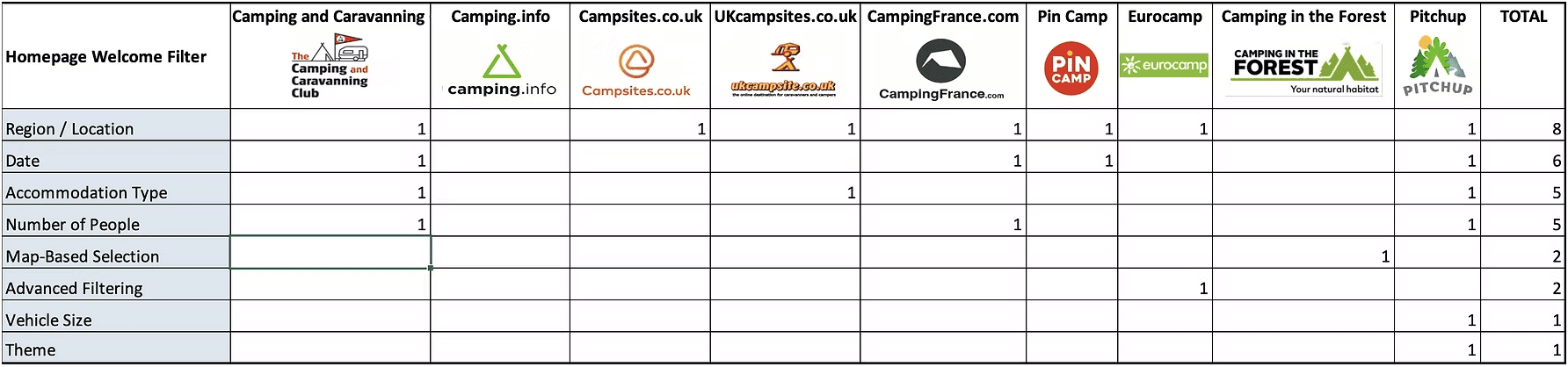
Since there was no legacy structure, I analysed domestic and international competitors across caravan rental and accommodation platforms to understand how filtering systems reflect booking intent.
Insight 01
Caravan rental decisions are specification driven. Users compare capacity, equipment, transmission type and technical features.
Insight 01
Caravan rental decisions are specification driven. Users compare capacity, equipment, transmission type and technical features.
Insight 01
Caravan rental decisions are specification driven. Users compare capacity, equipment, transmission type and technical features.
Insight 02
Campsite reservations are context driven. Users prioritise location, environmental conditions and available amenities.
Insight 02
Campsite reservations are context driven. Users prioritise location, environmental conditions and available amenities.
Insight 02
Campsite reservations are context driven. Users prioritise location, environmental conditions and available amenities.
Design goals
What I aimed to achieve
Structure dual inventory clearly
Define a modular architecture that separates caravan rental and campsite booking logic while maintaining a unified browsing experience.
Structure dual inventory clearly
Define a modular architecture that separates caravan rental and campsite booking logic while maintaining a unified browsing experience.
Structure dual inventory clearly
Define a modular architecture that separates caravan rental and campsite booking logic while maintaining a unified browsing experience.
Align filters with booking intent
Design contextual filtering models tailored to specification driven vehicle selection and location driven campsite discovery.
Align filters with booking intent
Design contextual filtering models tailored to specification driven vehicle selection and location driven campsite discovery.
Align filters with booking intent
Design contextual filtering models tailored to specification driven vehicle selection and location driven campsite discovery.
Build for operational scalability
Create a flexible structure that supports future expansion across fleet growth, new campsite categories and dynamic pricing models.
Build for operational scalability
Create a flexible structure that supports future expansion across fleet growth, new campsite categories and dynamic pricing models.
Build for operational scalability
Create a flexible structure that supports future expansion across fleet growth, new campsite categories and dynamic pricing models.
Design decision 01
One platform, two conflicting booking logics
Refining navigation across devices
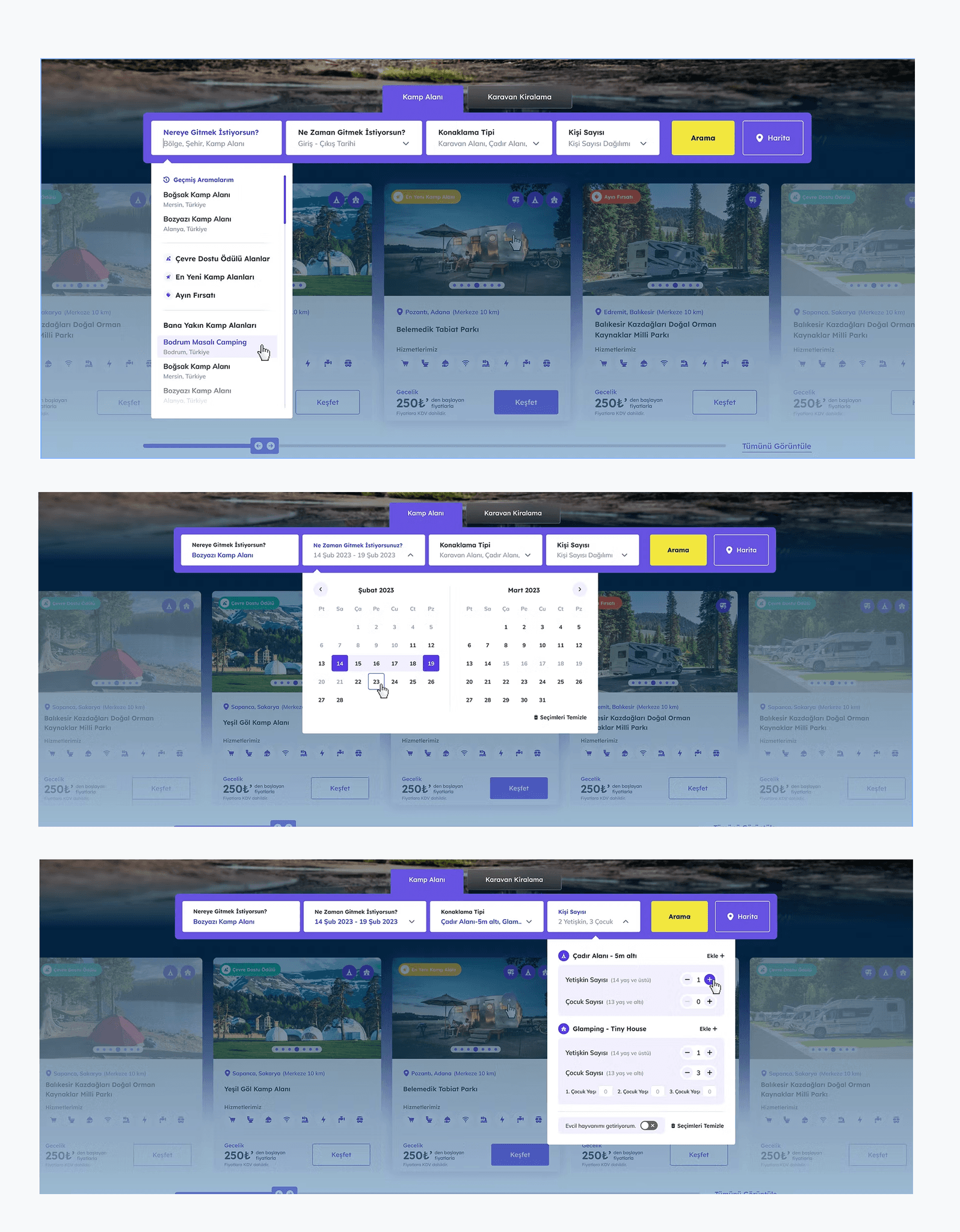
Although caravan rental and campsite reservations both result in a booking, they operate under different decision structures. Caravan rental is specification driven and asset based, while campsite booking is location focused and context driven.
While the information architecture was simplified at a structural level, navigation patterns still needed refinement across desktop and mobile. On desktop, I reorganised the mega menu to reduce visual density and group related categories more clearly. On mobile, filtering and key actions were repositioned to minimise friction and improve one-handed usability. The aim was to create a consistent experience across devices, balancing clarity with speed.
1. Shared filter structure
A unified filtering layout did not naturally reflect the differences between vehicle attributes and campsite amenities.
1. Shared filter structure
A unified filtering layout did not naturally reflect the differences between vehicle attributes and campsite amenities.
1. Shared filter structure
A unified filtering layout did not naturally reflect the differences between vehicle attributes and campsite amenities.
2. Ambiguous availability logic
Date selection and capacity rules varied across inventory types, yet the interface initially treated them similarly.
2. Ambiguous availability logic
Date selection and capacity rules varied across inventory types, yet the interface initially treated them similarly.
2. Ambiguous availability logic
Date selection and capacity rules varied across inventory types, yet the interface initially treated them similarly.
3. Blended mental models
Users approaching the platform for mobility or accommodation reasons required different entry points and contextual cues.
3. Blended mental models
Users approaching the platform for mobility or accommodation reasons required different entry points and contextual cues.
3. Blended mental models
Users approaching the platform for mobility or accommodation reasons required different entry points and contextual cues.
Problem 02
Operational complexity behind a unified interface
Refining navigation across devices
While the user experience needed to feel seamless, the operational structure behind the platform was inherently complex. Caravan inventory and campsite listings required different management workflows, availability rules and pricing structures.
Designing only the front end without aligning the back office logic would create long term system fragility.
While the information architecture was simplified at a structural level, navigation patterns still needed refinement across desktop and mobile. On desktop, I reorganised the mega menu to reduce visual density and group related categories more clearly. On mobile, filtering and key actions were repositioned to minimise friction and improve one-handed usability. The aim was to create a consistent experience across devices, balancing clarity with speed.
1. Distinct inventory management needs
Caravans required asset level tracking, maintenance status and date based availability control. Campsites required location level capacity management and seasonal configuration.
1. Distinct inventory management needs
Caravans required asset level tracking, maintenance status and date based availability control. Campsites required location level capacity management and seasonal configuration.
1. Distinct inventory management needs
Caravans required asset level tracking, maintenance status and date based availability control. Campsites required location level capacity management and seasonal configuration.
2. Dynamic availability dependencies
Booking states, cancellation policies and date blocking mechanisms varied across inventory types, requiring flexible administrative control.
2. Dynamic availability dependencies
Booking states, cancellation policies and date blocking mechanisms varied across inventory types, requiring flexible administrative control.
2. Dynamic availability dependencies
Booking states, cancellation policies and date blocking mechanisms varied across inventory types, requiring flexible administrative control.
3. Scalability risk
Without a structured management panel, expanding fleet size or adding new campsite partners would increase operational overhead and reduce system clarity.
3. Scalability risk
Without a structured management panel, expanding fleet size or adding new campsite partners would increase operational overhead and reduce system clarity.
3. Scalability risk
Without a structured management panel, expanding fleet size or adding new campsite partners would increase operational overhead and reduce system clarity.
Strategic Decision
Designing user and operational systems in parallel
To prevent structural misalignment, the user booking experience and the management panel were designed simultaneously. Instead of treating the admin interface as a secondary tool, it was structured as the operational backbone of the platform.
1. Mirrored inventory logic
The panel reflected the same inventory separation used in the user interface, clearly distinguishing between caravan assets and campsite locations.
1. Mirrored inventory logic
The panel reflected the same inventory separation used in the user interface, clearly distinguishing between caravan assets and campsite locations.
1. Mirrored inventory logic
The panel reflected the same inventory separation used in the user interface, clearly distinguishing between caravan assets and campsite locations.
2. Flexible availability control
Administrators could manage date blocking, capacity rules and seasonal pricing without disrupting the user facing structure.
2. Flexible availability control
Administrators could manage date blocking, capacity rules and seasonal pricing without disrupting the user facing structure.
2. Flexible availability control
Administrators could manage date blocking, capacity rules and seasonal pricing without disrupting the user facing structure.
3. Scalable configuration model
The system was built to support fleet growth and new campsite partnerships without requiring structural redesign.
3. Scalable configuration model
The system was built to support fleet growth and new campsite partnerships without requiring structural redesign.
3. Scalable configuration model
The system was built to support fleet growth and new campsite partnerships without requiring structural redesign.